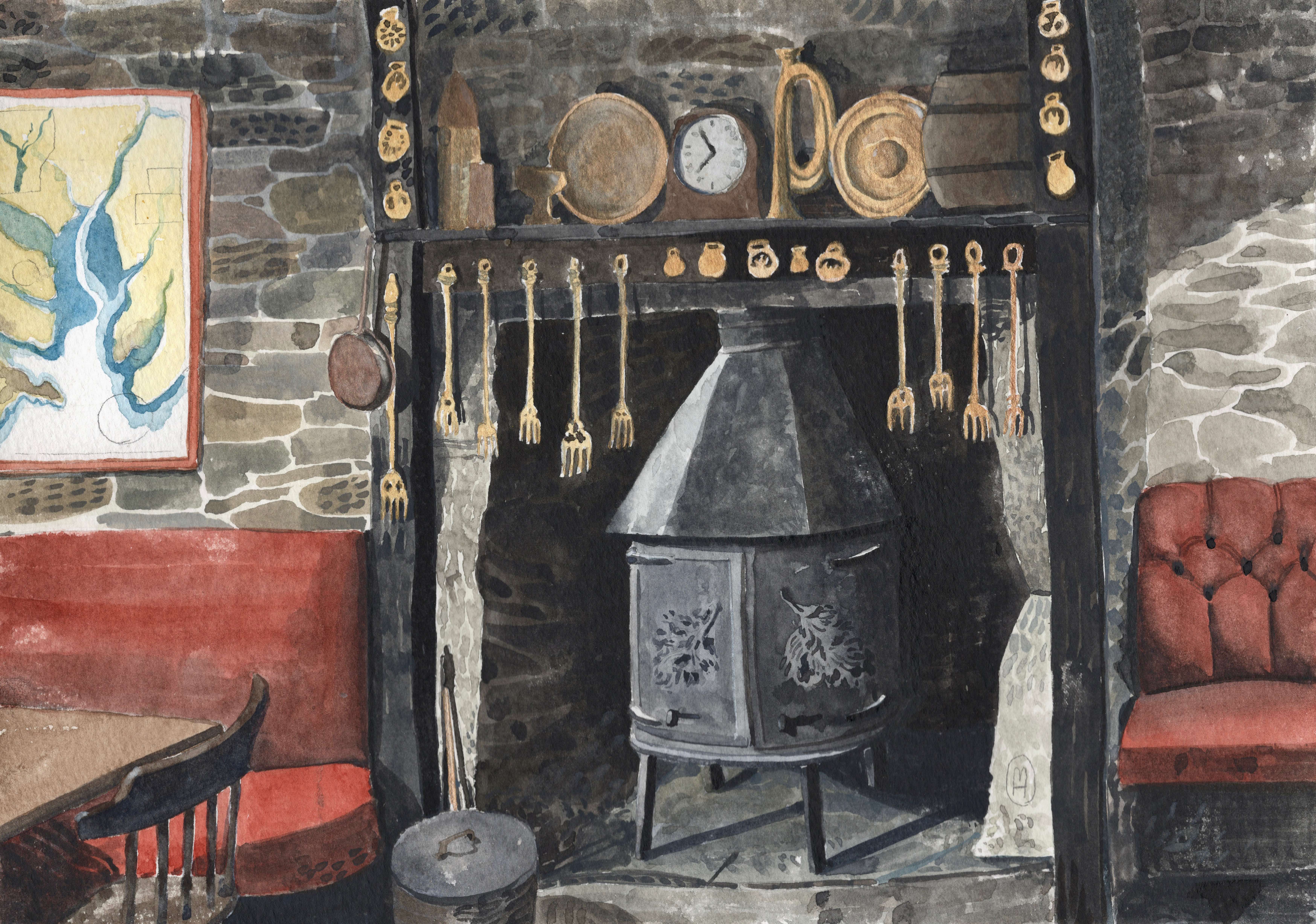
The Haunted Hare
Like 93%1 of the best village pubs The Hare sits opposite the village church: Saint Monacella and the Virgins. The church is said to have been placed on top of the ruins of a medieval chapel built by the Knights Templar; the circular cobbled floor is still visible inside. The churchyard is approximately 1.3 meters above the level of the path, elevated by centuries of interment of villagers. A previous landlord of The Hare used to say that you are not a true local until you had three generations buried in St. Cella’s, as it is colloquially called. The gateway into the church is guarded by a pair of yew trees said to be older than the church itself, though debate on this topic can get very heated. In addition to the yew trees there are several fine examples of variegated holly in the churchyard.
Relations between The Hare and St. Cella’s were civil until 1858 when Aldous Brears was replaced as the village vicar by Henry Frosthrup. Rev. Frosthrup had what was referred to as a “reforming zeal,” and within weeks of his appointment began preaching temperance in his sermons. The c6ngregation were able to ignore this until he began to call out by name villagers who wandered into the churchyard for a private moment after closing time. A small group of Hare regulars one night sent a young decoy couple to the Allerton Family Mausoleum. While the Reverend’s attention was presumably focused on the couple, the regulars stealthily searched until they found Henry Frosthrup watching from the bushes. Not long afterwards the Diocese quietly replaced him. Although the new vicar was uncontroversial to the point of forgettability, the former convivial relationship between the church and the pub was never fully recovered.
Contributed by Jessica Rose-Milliner